
Agents that work the open web for you.
A prompt is a request. An agent is a loop. The next generation of web software won't wait for you to ask — it will go out into the world, gather what's new, make something out of it, and ship it back. On a cadence.
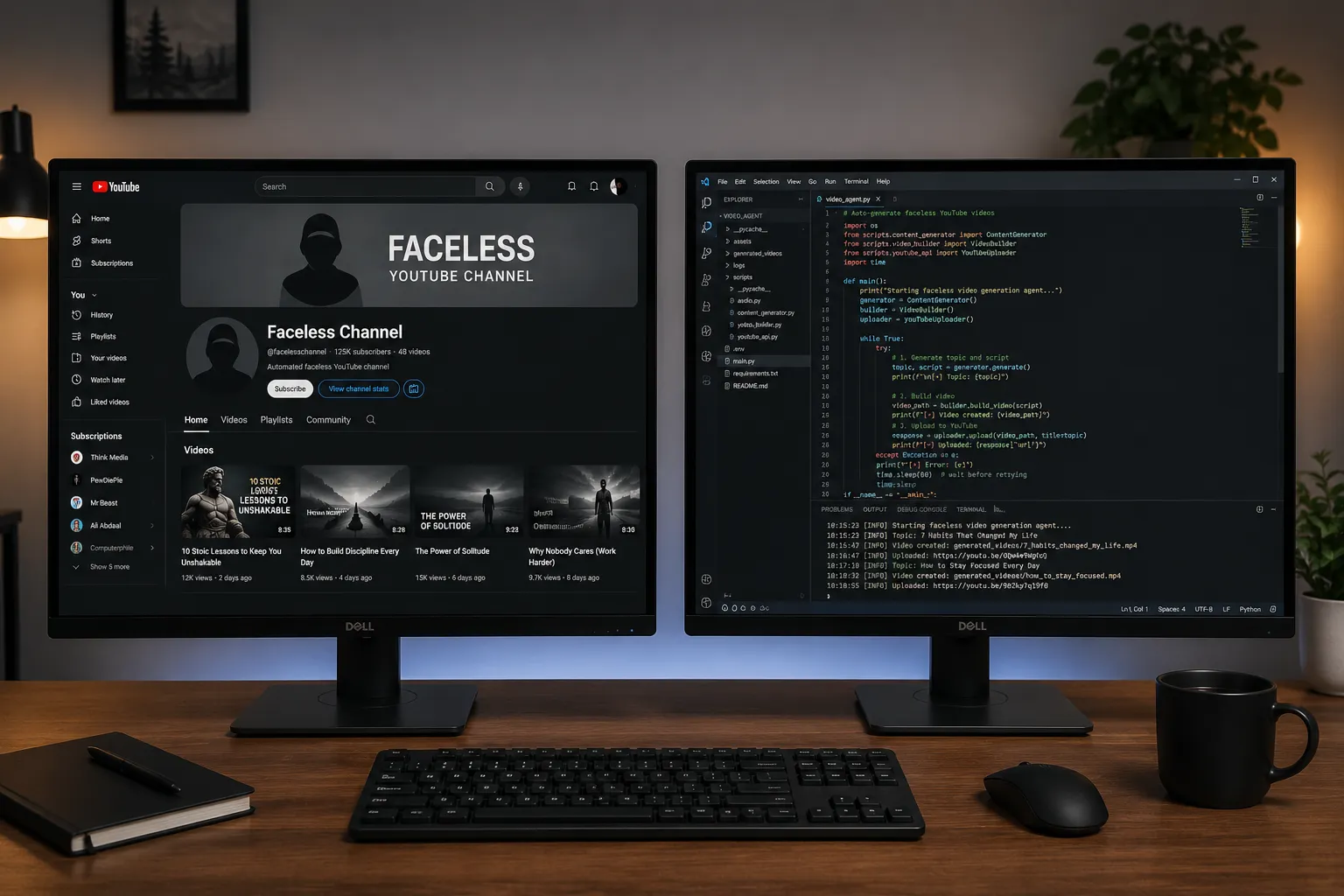
YouTube is a four-hundred-billion-dollar company because somebody figured out that video is the highest-bandwidth medium humans have. Agents are about to figure out the same thing, but from the other side. They're going to make video, not consume it. And the surface they'll do it on is the open web.
We call this category web agents. They are long-running pipelines, not chat sessions. They wake up on a schedule, crawl what's new, research what's interesting, generate something coherent, and publish it where the audience already is. The output is media: a clip, a podcast, a daily brief, a research deep-dive you can watch.
If desktop agents are about closing the loop on your screen, web agents are about closing the loop on the public internet.
The agentic stream
The hard part was never the model. It's holding state across a multi-hour run.
The hardest thing about web agents isn't the model. It's the loop. A good web agent is not one prompt. It's a hundred-step orchestration that includes crawling, summarizing, scripting, narration, assembly, and publishing. Most stacks fall apart by step three because they were never designed to keep state across a multi-hour run.
VideoDB is built around the concept of an agentic stream: a long-running media pipeline that an agent can drive end-to-end, with checkpoint memory at every step. The agent crawls. VideoDB indexes what was crawled. The agent narrates. VideoDB assembles. The agent publishes. VideoDB streams the result out as HLS.
"The web becomes a substrate the agent grazes on, day after day, and turns into something the audience can watch."
Four shapes builders are shipping
Four products, one loop: research, generate, publish — on repeat.
1. Faceless YouTube pipelines
The cleanest example of a web agent is the faceless YouTube channel. The agent picks a topic (or you do). It researches it across twenty sources. It writes a script. It generates a voice. It pulls B-roll from public domain archives, your stock library, or a model. It assembles. It publishes. The whole pipeline can run on a daily schedule, producing a video a day with no human in the loop.
This sounds dystopian until you realize what it actually unlocks: any niche too small to support a human creator now has a content stream. Long-tail education, hyper-local news, internal company knowledge — all suddenly viable.
2. Marketing agents that don't sleep
The campaign loop (brief, cutdown, distribute, measure) runs on a one-week cadence in most companies. Web agents collapse it to a one-hour cadence. The agent watches the source clip, generates channel-native variants (16:9, 9:16, 1:1), drops the brand mark, lays subtitles, queues to each surface. Every channel gets a fresh asset every day, custom-built for the audience there.
3. Micro-learning agents
The future of education is not a 50-minute lecture. It's a 90-second explainer, indexed, searchable, with a clip-level recall API. Web agents that read long-form content (lectures, podcasts, papers) and distill them into micro-lessons are the most under-loved category in this space. Once a company has indexed its own training material this way, internal knowledge transfer stops being a meeting.
4. Research agents with video outputs
The "deep research" pattern is mostly text today. That's about to flip. A research agent that produces a video brief (with clips as citations, not URLs) is dramatically more useful for the things humans actually want to know. "Show me what changed in the EV battery market this month" wants a watchable answer, not a 3,000-word essay.
What the runtime gives you
A daily research-to-video pipeline in a dozen lines.
The agent drives the loop; the runtime holds the state and does the heavy media work:
# A daily research-to-video pipeline
async def daily_brief(topic):
    sources = await vdb.crawl(topic, max=20)
    script  = await agent.draft(sources)
    timeline = vdb.timeline(script.segments)
    timeline.narrate(voice="editorial")
    timeline.overlay(brand="daily.png")
    return timeline.stream(format="hls")

# Schedule it
schedule.cron("0 6 * * *", daily_brief, "ev-batteries")
State, not statelessness
Every step in an agentic stream commits to a memory the agent can recall later. Day 30 of the loop can see what Day 1 produced. The agent gets better at the topic the longer it runs.
Why this is the next platform shift
Machines make the media, machines distribute it — the economics are unrecognizable.
The default loop of the consumer web for two decades has been: humans make content, machines distribute it. Web agents flip both halves. Machines make the content, machines distribute it, humans curate and consume. The economics are unrecognizable. The cost to produce a piece of media drops by three orders of magnitude. The number of channels that can be served goes up by six.
The companies that win will be the ones that figured out the agentic-stream stack early. Not the ones with the best prompt. The competitive moat is going to be the loop, the memory, and the publishing pipeline. VideoDB is exactly that stack.